Automate or Hire? The Framework for Your Startup's Hardest Recurring Decision

Every founder hits this wall, usually around 11pm: the work is officially too much. Something has to give. And the classic reflex kicks in — we need to hire someone.
Maybe. But it's 2026, and that reflex was installed in an era when a job posting was the only fix for an overflowing plate. Today there's a second door: for a growing share of the work drowning you, the next "hire" can be a workflow that costs 15–25% as much, starts on Monday, and never asks for equity.
The automate vs hire question isn't philosophical anymore — it's a recurring budget decision you'll make a dozen times as you scale. Get it right and you stay lean without dropping balls. Get it wrong in one direction and you burn cash on salaries for robot work; get it wrong in the other and you've automated away the human touch that made customers love you.
Here's the framework we use, the real numbers behind it, and the honest list of where each option wins.
The reflex is expensive: what hiring actually costs
Founders chronically underestimate hiring costs, because the salary is just the visible part of the iceberg.
Before your new person does an hour of work, recruiting alone averages $4,700 per hire — and over $20,000 for specialized roles. Then the salary gets "loaded": taxes, benefits, equipment, software seats, and management overhead push the true annual cost well beyond the number on the offer letter. Then add ramp time — months where you're paying full price for partial output — and the risk multiplier: a mis-hire costs you the money and the months.
None of this means don't hire. It means the bar for "this problem needs a salary" should be higher than "I'm overwhelmed."
The automation column, for contrast: a typical build handling 10–20 hours a week of repetitive work — follow-ups, data entry, scheduling, reporting, first-line support — runs a one-time $2,000–7,000 plus modest monthly tooling. For repetitive work specifically, automation delivers comparable output at roughly 15–25% of the cost of a hire. It also starts immediately, doesn't churn, and scales without a second salary.
The catch — and it's a real one — is that automation only delivers those numbers on the right kind of work. Which brings us to the scorecard.
The 5-question scorecard
For any pile of work you're about to solve with a job posting, score it 1–5 on each question:
1. Is it repetitive? Does the task follow roughly the same steps every time? (5 = identical every time; 1 = different every time)
2. Is it rule-based? Could you write down the decision logic — "if X, then Y" — even if the list is long? (5 = fully describable; 1 = "it depends" all the way down)
3. Is it high-volume? Does it happen many times a week? (5 = dozens of times daily; 1 = a few times a quarter)
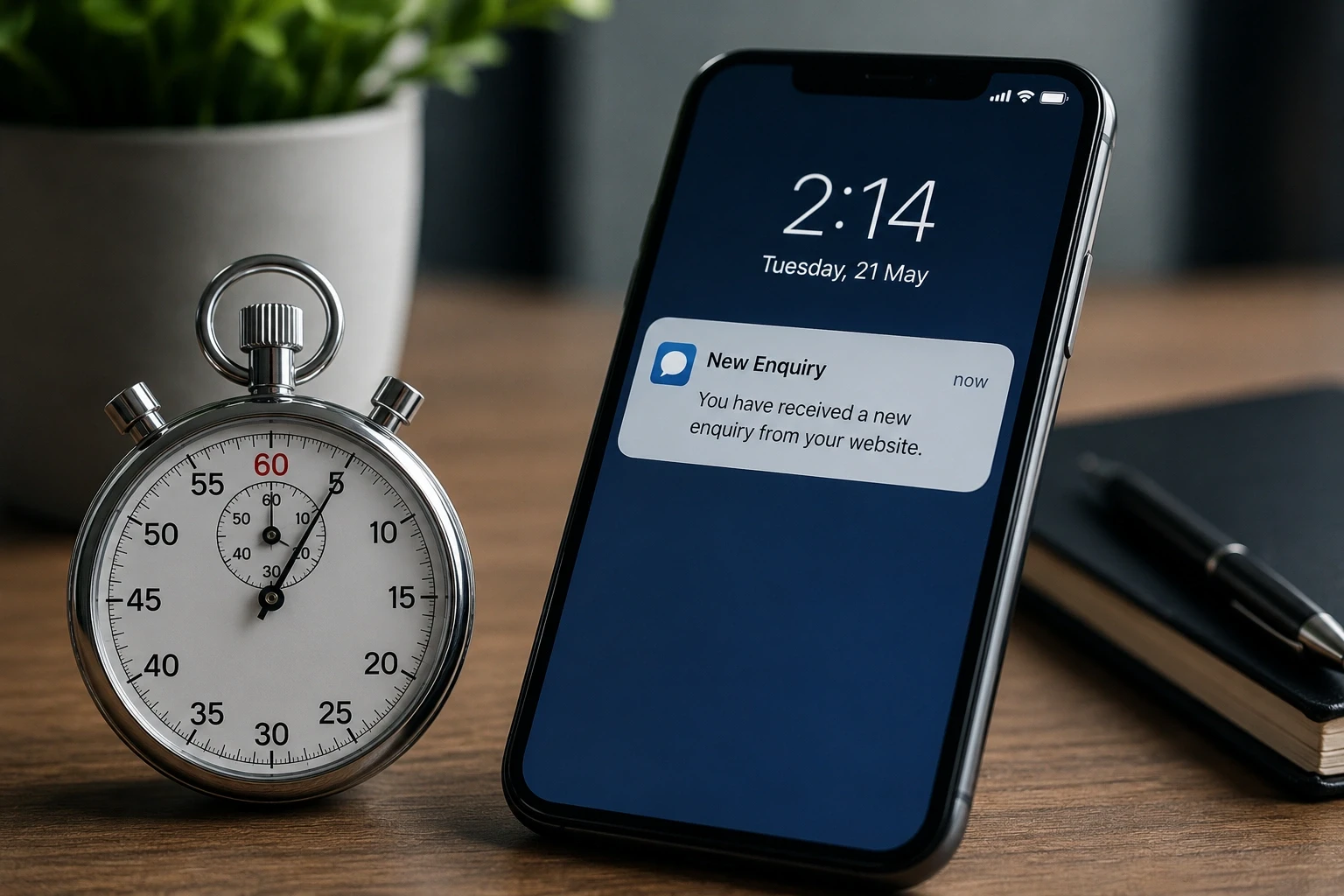
4. Is it time-sensitive? Does doing it instantly beat doing it thoughtfully? Lead response is the canonical example — speed wins deals, and no human wins a speed contest with a webhook. (5 = seconds matter; 1 = next week is fine)
5. Is it relationship-light? Would the other party mind — or even notice — that a system did it? (5 = nobody cares; 1 = the relationship IS the work)
Score 18–25: automate first. This is robot work. Hiring a human for it is unkind to the human and expensive for you.
Score 12–17: automate the skeleton, keep a human in the loop. Let the system do the collecting, drafting, and routing; a person reviews and adds judgment. Most support and sales workflows live here — an AI chatbot with a clean human handoff is the textbook case.
Score below 12: hire (or do it yourself a while longer). Low-volume, judgment-heavy, relationship-dependent work is human work. Automating it produces the uncanny-valley experiences customers rant about.
The most useful discovery founders make running this exercise: a "role" is rarely one score. The "ops manager" you were about to hire is actually six tasks — four of which score 20+, two of which score 8. Automate the four, and suddenly the remaining two don't justify a full-time salary yet. That's the pattern behind Inc.'s finding that 40% of small business owners said automation reduced the number of roles they needed to fill — they still hired, just for different, better jobs.
Not sure how your workload scores? This audit is literally the first thing we do with clients at Origo — we map your recurring work, score it, and tell you honestly which parts need a workflow and which need a human. Book a chat and bring your messiest week.
Where each option wins: the honest list
Automation wins, almost every time: lead capture and instant response, first-line customer support, data entry and syncing between tools, meeting notes and summaries, invoice chasing, report compilation, appointment scheduling, review requests, email sequences. If it made you sigh just reading the list, that's the tell.
Humans win, almost every time: closing deals that need trust, product and strategy decisions, creative direction and taste, handling upset customers whose value justifies the save, partnerships, anything where accountability matters ("the algorithm did it" is not an apology), and any task you haven't done manually enough times to understand — because automating a process you don't understand just scales your confusion.
The hybrid — where 2026's most efficient teams actually live: systems do the repetitive layer, humans do the judgment layer, and the boundary between them is a designed handoff, not a gap things fall through. The consensus across the research is blunt: the most efficient service businesses now run exactly this model — automation handles rule-based work, the team handles everything requiring skill or relationship.
Three traps on each side
If you over-hire: you get payroll that scales linearly with workload (the opposite of leverage), people doing work that quietly demoralizes them, and a team you may have to shrink in a downturn — the most painful sentence in founder life.
If you over-automate: you get customers who feel processed instead of served, edge cases falling into the gap between workflows, and — the sneaky one — a business you no longer understand, because the founder stopped touching the work before the process was mature. Rule of thumb from our pillar guide: do it manually at least 20 times before you automate it.
Either way, revisit quarterly. The scorecard isn't a one-time exam. Volume grows, tools improve, and a task that scored 11 last year might score 19 now. The automate-vs-hire line moves — usually in automation's favor — so re-run the numbers before every hiring decision.
Frequently asked questions
Should a startup automate or hire first? Automate the repetitive, rule-based, high-volume work first, then hire for judgment, creativity, and relationships. Most startups discover their planned "first ops hire" was 60–70% automatable tasks, which delays the hire until it's genuinely about human skills.
How much cheaper is automation than hiring? For repetitive work, roughly 15–25% of the cost. A typical automation build handling 10–20 hours a week of admin work costs $2,000–7,000 one-time plus modest monthly tooling, versus a loaded salary plus ~$4,700+ in recruiting costs per hire.
What tasks should never be automated? Deal-closing, strategy, creative direction, high-stakes communication, and anything relationship-dependent or too rare to have stable rules. Also anything you haven't personally done enough times to define — automate understanding, not confusion.
Does automation replace jobs at startups? It mostly replaces tasks, not roles. Surveys show about 40% of small business owners needed fewer of the roles they'd planned — but they still hired, redirected toward judgment-heavy work that actually justifies a salary.
How do I know when it's finally time to hire? When the remaining human-only work — the judgment, relationships, and creativity left after automation — consistently exceeds the hours you and your team can give it. At that point hire eagerly: you'll be hiring for a genuinely good job, and your automation stack makes every hire more productive from day one.
Can I automate first and hire later without redoing everything? Yes — that's the ideal sequence. Well-built workflows become the infrastructure your future hires inherit: documented processes, clean data, and handoffs. New people onboard faster because the boring parts already run themselves.
The bottom line
"We need to hire someone" is sometimes true. But in 2026 it's a conclusion, not a starting point. The starting point is the scorecard: score the work, automate what robots do better, and spend your precious salary budget on the humans-only layer — where a great person is worth every rupee, dollar, or euro you pay them.
Lean isn't about doing less. It's about never paying a person to be a workflow.
Origo Studios helps startups run exactly this play — we build the AI automation layer and the marketing engine so your team can stay small and mighty. See what we've built or tell us where you are — we'll take it from there.